
FTQC
Scalable Fault-Tolerant Quantum Computing (FTQC)
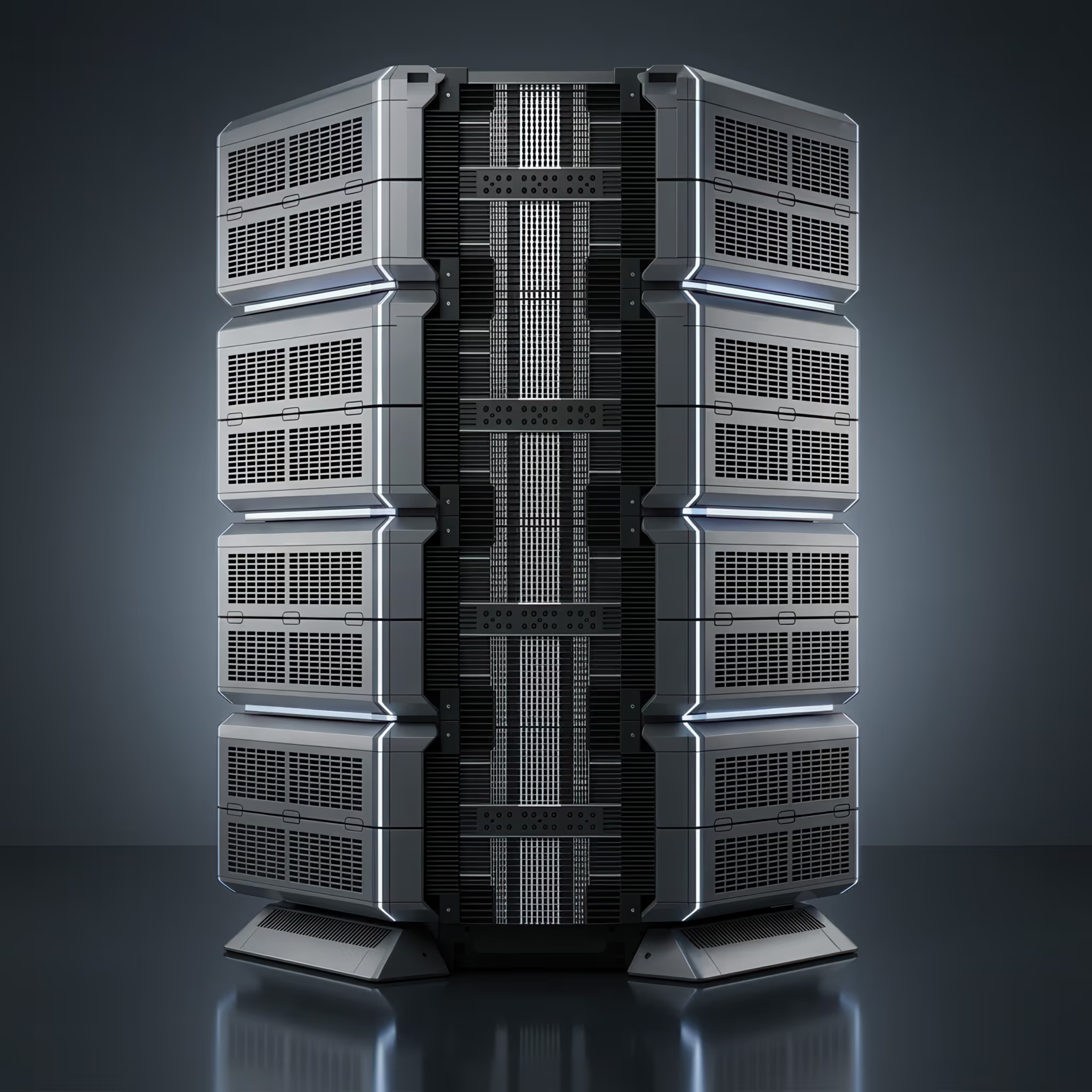
Scalable Fault-Tolerant Quantum Computing for the Next Era of IT
nanoFlowcell establishes scalable fault-tolerant quantum computing (FTQC) as a technological foundation. The focus lies on logical qubits, surface-code quantum error correction, systemic scalability and reliable large-scale quantum computation.
Abstract
At nanoFlowcell, fault-tolerant quantum computing is not treated as a distant future concept. It forms part of an existing technological foundation. Our quantum architecture is designed as a modular and scalable platform that establishes the conditions for logically reliable quantum computation beyond the NISQ regime.
The central element of our FTQC approach is the controlled transformation of physical qubits into stable logical qubits. The decisive factor is not the sheer number of physical qubits but their integration into an architecture that combines fault tolerance, scalability and operational viability.
Scalable FTQC introduces a new stage of information processing. Once logical error rates become controllable and deeply scalable quantum operations can be executed reliably, the foundation of what can be computed in simulation, security, optimisation and artificial intelligence changes fundamentally.
1. Scientific Background
The Transition from the NISQ Regime to FTQC
Many present-day quantum systems are still constrained by physical error rates that are insufficient for deep and practically relevant quantum algorithms. The transition to fault-tolerant quantum computing begins when errors are not only detected but systematically controlled and suppressed at the logical level.
Why the Surface Code Is Critical
The surface code provides a central foundation for this transition. It combines a high error threshold with favourable locality properties and illustrates how physical stability, logical reliability and architectural protection mechanisms interact. This demonstrates that fault-tolerant quantum computing does not emerge accidentally but results from precisely controlled error-correction logic.
Scientific Foundations of the Architecture
The scientific relationships underlying FTQC show that logical error rates can be systematically reduced as error-correction depth increases. At the same time, the required physical resources follow a clear scaling logic. The interaction between these factors forms the basis of a robust quantum architecture.
The Technological Leap
This shift fundamentally changes the focus of modern quantum information science. Individual qubits are no longer the central concern. The decisive capability lies in transforming large numbers of physical qubits into a coherent, fault-tolerant and operationally controllable system. This transformation represents the actual technological leap enabled by FTQC.
2. Architectural Principle
Modular Structure for Scalable Quantum Computing
The FTQC architecture developed at nanoFlowcell is built from clearly defined components that operate together as a coordinated system. These components include parameterisable surface-code patches, parallel error-correction cycles, a dedicated resource layer for non-Clifford operations, and an integrated energy and thermodynamic infrastructure.
Logical Qubits as Scalable Modules
Logical qubits are implemented as scalable modules whose protection level can be deliberately configured. Robustness therefore appears not as a fixed characteristic but as a controllable operational parameter within the overall architecture for fault-tolerant quantum computing.
Error Correction as an Operational Function
Error correction is not an auxiliary mechanism but part of continuous system operation. Parallel QEC cycles, stabilizer measurements and optimised syndrome processing are integral elements of the architecture. Fault tolerance therefore emerges directly within the system’s operational process.
Magic States and Universal Quantum Logic
Stabilising logical qubits alone is insufficient for universal quantum computation. The architecture therefore includes a dedicated magic-state resource layer that enables efficient and controlled implementation of non-Clifford operations. This layer transforms error correction into a complete logical computing architecture.
Embedded in an Existing Quantum Platform
FTQC does not exist in isolation. It operates within a broader quantum architecture in which modularity, parallelism and systemic integration already form a coherent technological foundation. The fault-tolerant layer extends this base by enabling logical stability to be maintained persistently and at scale.
3. Target Parameters and Technological Positioning
The Interplay of the Key Factors
Fault-tolerant quantum computing cannot be characterised by isolated metrics. Its feasibility depends on the precise interaction between several critical parameters. These include physical error rates below threshold values, sufficiently large protection distances within the error-correction code, extremely low logical error rates and the ability to scale to large numbers of usable logical qubits.
Controlled Stability Instead of Hardware Expansion
Scientific results show that logical stability improves systematically as the depth of error correction increases. At the same time, higher logical reliability always corresponds to a clearly defined requirement for additional physical resources. Fault-tolerant quantum performance therefore results not from simple hardware expansion but from controlled error suppression and predictable architectural scaling.
The Transition to an Operational Computing Infrastructure
These target parameters mark the point at which quantum architectures evolve from experimental systems into operational computing infrastructure. They define the conditions under which quantum computing becomes practically applicable to areas such as material simulation, quantum-assisted optimisation and cryptographically relevant problem classes.
4. Systemic Scalability
Scaling as an Architectural Capability
The FTQC architecture is designed as a cluster-based infrastructure consisting of logical qubit blocks, QEC control layers, high-bandwidth interconnects and real-time decoding units. Scaling in this context does not mean simply enlarging individual components but coordinating all system layers so that they operate as a stable and coherent whole.
Interconnect and Real-Time Operation
Fault-tolerant quantum computing becomes practical only when data flow, routing, decoding and error handling interact in real time. The interconnect therefore serves not merely as a connection mechanism but as a central structural element of the architecture.
Cryogenic and Energy Integration
The thermodynamic layer is equally essential. Cryogenic infrastructure, energy supply and hardware-coherent system layouts are integral parts of the platform. Fault tolerance therefore depends not only on quantum logic but also on operational physics and infrastructural coherence.
The Deeper Meaning of Scaling
The broader significance of this development becomes particularly visible in the context of scaling. The transformation of information technology does not arise from a single component but from the capability to integrate computational logic, error control, energy infrastructure and data flow within a new architectural framework. In this sense, FTQC represents the operational logic of a new generation of digital systems.
5. Scientific Significance
From Theory to a Robust Platform
The scientific importance of FTQC lies in translating the theoretical requirements of universal quantum algorithms into a physically and architecturally robust platform. The decisive progress lies not in the number of physical qubits but in the controlled reduction of logical error rates as circuit depth increases.
Beyond High-Performance Computing
This development extends far beyond a specialised field of quantum physics. It affects security, cryptography, simulation, optimisation and emerging forms of AI-driven data processing. FTQC therefore appears not as an isolated technology but as the starting point of a broader transformation of digital systems.
Historical Significance
For this reason the transition is not merely an incremental improvement of existing information technology. It represents a structural transformation. Once fault-tolerant quantum computers become stable, scalable and systemically integrated, the foundations of what can be computed in research, industry, security and digital infrastructure will fundamentally change.
6. Conclusion
A Clear Starting Point
FTQC does not represent the beginning of a purely theoretical development. The technological foundation already exists, and topological error correction, modular cluster architecture and systemic scalability together form a coherent framework.
The Architectural Consequence
At its core, the challenge is to transform physical quantum instability into logical computational stability. Error correction, modular architecture, real-time decoding and energy integration converge into a platform designed for long-term scalability and practical operation.
The Fundamental Significance
FTQC does not simply introduce another quantum architecture. It marks the transition to a new quality of computability. This is the central significance of the technology. It establishes the conditions under which quantum computing can evolve from an experimental special case into the infrastructural foundation of future digital systems.